The World of Regression Testing for Cloud Enterprise Apps
Regression testing is one of the most critical pillars of software quality assurance for your cloud enterprise applications. Every time a development team ships new features, patches bugs, or refactors code, regression testing ensures that what worked yesterday still works today. Without it, even a minor update can break core functionality, a risk no enterprise can afford.
Yet, despite its importance, many teams struggle to execute regression testing efficiently at scale. Tests grow stale, coverage gaps widen, and manual effort becomes unsustainable as application complexity increases. The good news? A smart, disciplined approach to regression testing powered by the right strategy can turn this challenge into a competitive advantage.
What are the 10 regression testing best practices that high-performing cloud application teams use to ship with confidence, reduce defect rates, and keep their test suites lean and effective?
Key Insight: Studies consistently show that companies following structured regression testing practices detect defects up to 3x faster and report significantly higher customer satisfaction scores than teams relying on ad hoc testing alone.
Regression testing best practices include prioritizing high-risk test cases, automating repetitive checks, and running suites on every release. Opkey applies AI to automatically prioritize and execute regression test cases for Oracle, SAP, and Workday releases, reducing manual regression effort.
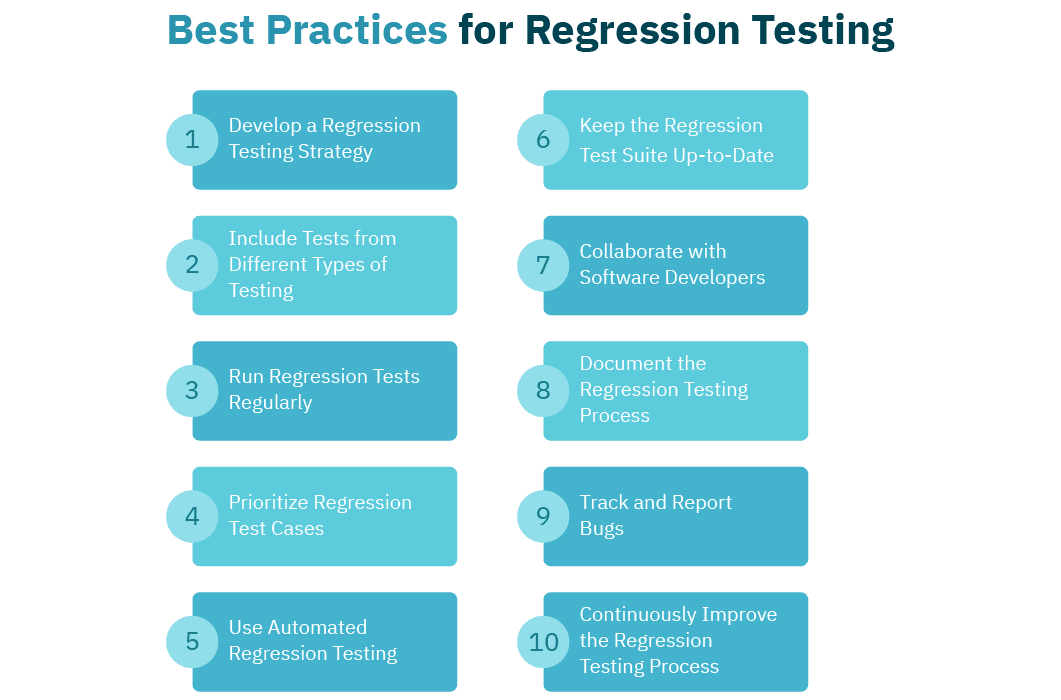
10 Regression Testing Best Practices
1. Build a Risk-Based Regression Testing Strategy: Not all features carry the same risk, and your regression test suite should reflect that reality. Start by mapping your enterprise application’s most critical workflows. These are the ones that, if broken, would have the highest impact on users or business operations. Use this risk analysis to determine which test cases belong in every regression run and which can be executed on a less frequent cycle.
Your strategy should define:
- Which test cases are run on every code commit (smoke suite)
- Which are run before every release (full regression suite)
- Which are run on a scheduled or risk-triggered basis
Revisit and update this strategy with every major release cycle. A regression strategy that was right six months ago may not account for new modules, integrations, or user flows.
2. Build a Diverse Regression Test Suite: A regression test suite that only tests one layer of the application is a suite with blind spots. The most resilient suites draw from multiple testing disciplines:
- Functional tests: validate that features behave as specified
- Unit tests: verify individual components in isolation
- Integration tests: confirm that modules interact correctly
- End-to-end tests: simulate real user journeys across the full stack
- Manual exploratory tests: uncover edge cases that automation may miss
This diversity ensures that regressions are caught at the layer where they are cheapest to fix. The goal is to fix issues before they ever reach production.
3. Run Regression Tests Continuously: The longer you wait to run regression tests, the more expensive failures become. Best-in-class enterprise teams integrate regression testing directly into their CI/CD pipelines, triggering automated suites on every code commit or merge request.
At a minimum, run your core regression suite after every significant change and your full regression suite before every release. Early detection means smaller blast radius, and faster time to resolution.
4. Prioritize Test Cases by Business Impact: With hundreds or thousands of test cases, prioritization is essential. Assign each test case a priority tier based on factors like:
- Frequency of use — how often do users interact with this feature?
- Business criticality — does this feature directly affect revenue or compliance?
- Historical defect rate — has this area been a source of bugs in the past?
- Dependency footprint — how many other features rely on this one?
High-priority test cases should always be in scope, even for rapid hotfix releases. Lower-priority cases can be deferred to full regression runs.
5. Embrace Automated Regression Testing: Manual regression testing at scale is neither sustainable nor reliable. Automation not only increases efficiency, it also drastically increases the quality of testing. Automated regression tests execute faster, run more frequently, and produce consistent results without the variability of human execution.
Smart testing platforms designed for enterprise environments like Opkey CALM (Cloud Application Lifecycle Management) take this a step further. CALM enables teams to automate complex, multi-step test scenarios across enterprise applications, dramatically reducing manual effort while increasing coverage and accuracy.
Aim to automate all stable, repeatable regression scenarios. Reserve manual testing for exploratory work, usability validation, and rapidly evolving areas of the application.
6. Keep Your Regression Suite Evergreen: A regression suite that is not maintained is a liability. As your application evolves, tests that were once relevant can become outdated, brittle, or outright wrong. Set a cadence for test suite maintenance reviewing and updating test cases whenever:
- New features are added or existing features are significantly changed
- UI or workflow changes affect user journeys
- APIs or integrations are updated
- Flaky tests are identified and need remediation
An evergreen test suite ensures your regression coverage reflects the actual state of your application, not a snapshot from months ago.
7. Collaborate Closely with Development Teams: Regression testing should not be an afterthought that happens at the end of a sprint. The most effective teams embed QA thinking into the development process from day one. This means:
- Involving testers in requirement and design reviews
- Developers writing or reviewing unit and integration tests alongside their code
- Shared visibility into test results and failure trends
- Joint retrospectives to identify recurring defect patterns
When development and QA teams operate as partners rather than handoff points, regression defects are caught earlier and resolved faster.
8. Document Your Testing Process Thoroughly: Documentation is the backbone of a repeatable, scalable testing process. A well-documented regression testing process includes:
- Test case descriptions, steps, expected outcomes, and current status
- Testing frequency and trigger conditions for each suite
- Criteria for adding or retiring test cases
- Ownership and accountability for each area of the suite
- Historical test results and trend data
Good documentation reduces onboarding time for new team members, ensures consistency across testing cycles, and makes it easier to audit your testing process when needed.
9. Track, Triage, and Report Defects Systematically: Finding defects is only half the battle the other half is ensuring they are properly tracked, routed to the right owners, and resolved. Establish a defect management workflow that captures:
- Steps to reproduce and affected environments
- Severity and business impact classification
- Assigned owner and target resolution date
- Verification status after the fix is deployed
Regular defect reporting shared with both QA and development leadership creates visibility into quality trends and helps teams address systemic issues before they compound.
10. Continuously Improve Your Regression Testing Process: Regression testing is not a set-and-forget discipline. The best teams treat their testing process as a product in its own right continuously measuring its effectiveness and iterating to improve it.
Key metrics to track include test pass/fail rates over time, defect escape rate (defects found in production that were not caught in testing), test execution time, and coverage gaps. Use these signals to make data-driven decisions about where to invest in additional automation, where to refine test cases, and where to retire obsolete coverage.
Schedule quarterly retrospectives specifically focused on testing effectiveness. Small, regular improvements compound over time into a significantly more reliable testing operation.
What Methods Are Commonly Used for Smart Testing in Enterprises?
Cloud application ecosystems like Workday, Oracle, and Salesforce are more complex than ever, spanning cloud environments, mobile platforms, APIs, and deeply integrated business applications. Smart testing in enterprise environments typically involves a layered combination of tools working in concert:
- Opkey CALM (Cloud Application Lifecycle Management) — a purpose-built platform for enterprise test automation and continuous quality management. CALM enables teams to design, execute, and manage automated test suites across complex enterprise application landscapes with minimal manual intervention, and also offers automated configuration, training, and more.
- CI/CD Pipeline Tools (e.g., Jenkins, GitHub Actions, Azure DevOps) — integrate regression test execution directly into the build and deployment pipeline for continuous feedback.
- API Testing Tools (e.g. REST-assured) — validate backend services and integrations independently of the UI layer.
- Performance Testing Tools (e.g., JMeter, Gatling) — ensure that application performance does not degrade following code changes.
- Test Management Platforms — centralize test case management, execution reporting, and traceability across the testing lifecycle.
The right approach depends on your application’s technology stack, your team’s maturity, and the complexity of your enterprise environment. What matters most is that your tools integrate well with each other and with your development workflow enabling fast, reliable feedback at every stage of the delivery pipeline.
Accelerate Your Regression Testing with CALM
Opkey CALM — Cloud Application Lifecycle Management — is a comprehensive platform purpose-built for enterprise teams that need to move fast without sacrificing quality. CALM brings together test design, automation, execution, and reporting into a unified workflow that scales with the complexity of modern enterprise environments.
With CALM, software testing teams can:
- Rapidly build and maintain automated regression test suites without deep scripting expertise
- Execute tests across enterprise application modules with full traceability
- Integrate regression runs natively into CI/CD pipelines for continuous quality gates
- Gain real-time visibility into test results, coverage, and defect trends through centralized dashboards
- Reduce regression cycle times dramatically
By centralizing the entire testing lifecycle within CALM, enterprise teams eliminate the fragmentation that comes from stitching together multiple disconnected tools and gain a single source of truth for application quality.
Final Thoughts
Regression testing ensures the reliability of your core digital infrastructure, and in turn bolsters your business reputation. The teams use automation validate changes faster, supply more features, and catch more bugs.
By implementing the ten best practices outlined in this guide will be well positioned to deliver software that users can count on, release after release.
Start small, automate strategically, collaborate relentlessly, and improve continuously. That is the formula for regression testing that genuinely protects your software and your users.
Ready to transform your regression testing process?