Starting in June 2026, Oracle introduced mandatory monthly updates for all Fusion Applications. If you’re responsible for keeping your Oracle environment secure while ensuring critical business processes continue to run smoothly, this new release cadence changes the way you plan and operate. You now have less time to assess and validate changes, more updates to manage, and greater pressure to keep the business running without disruption.
Here’s the situation, what it actually costs you if you don’t adapt, and what to look for if you’re deciding how to handle it.
What changed, in business terms
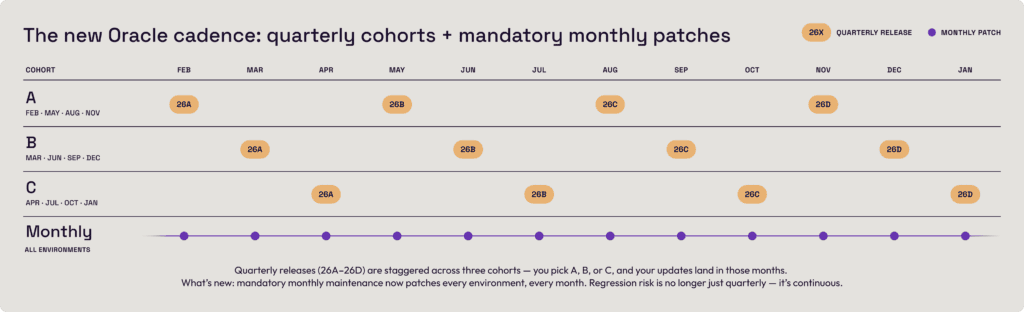
Oracle has always run quarterly updates across Cohorts A, B, and C, that part hasn’t changed. What has changed is a second, parallel cycle layered on top: mandatory monthly maintenance, plus a brand-new monthly Critical Security Patch Update (CSPU). Put the two together and 4 change events a year just became 12 or more- and unlike before, there’s no opting out or rescheduling around it.
To see what that actually looks like in practice, take Oracle’s June 2026 Critical Patch Update.
It included 245 new security patches across Fusion Middleware, E-Business Suite, JD Edwards, PeopleSoft, and Siebel. Many of the vulnerabilities could be exploited remotely without authentication, according to Oracle’s advisory That means postponing certification until “next sprint” is no longer just a scheduling decision, it can become a real security risk.
And the timeline leaves little room for mistakes. With Oracle now locking Critical Patch Updates to the third Tuesday of every month, teams have less runway than ever to assess what changed, certify their applications, and close the gap before it’s exposed.
So, why should this land on a decision-maker’s desk and not just QA’s? Because it’s not just another update to schedule around- it’s a workload that keeps growing while the time to handle it keeps shrinking. Falling behind here doesn’t just mean a late regression cycle. It’s the reason teams are moving impact analysis earlier, before the window opens, instead of after.
Why this can’t be waved off as “just a security patch”
There’s a natural instinct to route security-labeled releases around QA: “It’s just a security fix, it doesn’t touch business logic.” Oracle’s own guidance says otherwise: these updates modify product code, and even purely security-focused changes can affect integrations, validations, and business processes. Oracle explicitly recommends validating critical processes after every update window, not just the quarterly ones.
RICE components, OIC integrations, BI Publisher reports, and page personalization have always been your team’s responsibility to verify, every single cycle. That’s not a testing nice-to-have, it’s the part of the risk that sits on your books.
How Opkey helps with monthly mandatory updates
Opkey’s platform is purpose-built for Oracle’s mandatory monthly update cadence, helping organizations manage patch volume, accelerate testing, and stay release-ready within increasingly shorter timelines.
Opkey isn’t a single script runner, it’s an AI agent-driven platform that plans, tests, configures, and validates across the Oracle Fusion lifecycle. The Testing Agent specifically handles certification: it executes regression targeted at what a given patch actually touched, rather than blindly re-running your entire suite every month.
Opkey Release Advisor: impact analysis before the window opens
Release Advisor is an Oracle release readiness tool that tells IT Directors and QA leads which release changes map to their Oracle Cloud environment, what to configure, test, and train on, so teams can certify releases in days, not weeks.
Most testing approaches start after the patch lands: you find out what changed by running tests against it. Opkey Release Advisor moves that step earlier. It reads each Oracle patch and maps it directly to your live modules, configurations, integrations, and customizations before the maintenance window even opens.
A pre-built test library, so you’re not starting from zero
Opkey ships 7,500+ pre-built Oracle Fusion test cases covering ERP, HCM, SCM, and more. That matters directly for the resourcing problem: building and maintaining regression coverage from scratch for twelve cycles a year isn’t realistic for most teams, and a ready library removes that upfront build cost entirely.
Self-healing scripts, so coverage survives Oracle’s own changes
Interface changes like Oracle’s Redwood UI updates are exactly the kind of thing that normally breaks brittle test scripts, forcing manual rework every single cycle. Opkey’s self-healing automation adapts scripts automatically when Oracle changes its UI, so test maintenance overhead doesn’t quietly eat the ROI of the automation in the first place.
Put together, the sequence looks like this: Opkey Release Advisor tells you what a patch touches before the window opens, the Testing Agent certifies it fast once you’re inside the window, the pre-built library means you’re not building coverage from scratch, and self-healing scripts mean that coverage still works next month, and the month after that.
The window you have to work with, and why it doesn’t scale
For Oracle-managed SaaS applications, the timeline is tight and non-negotiable. Non-production environments are typically patched in the middle of the week, with production following just a few days later over the weekend. That gives teams only about three days to validate changes before they go live.
That means even less time to test, validate, and prepare, making an already compressed release cycle even harder to manage.
Two weeks were fine once a quarter. It is a materially different resourcing problem 12 times a year:
- Headcount doesn’t change, but cycles triple. If your team used to spend an entire week each quarter on manual validation, that same workload now repeats every month- with the same team and no additional resources. That’s the new reality many organizations are facing.
- The margin for error shrinks. When Oracle released updates every quarter, missing a regression test might have been an occasional risk. With monthly releases, that same gap doesn’t just repeat; it compounds, creating ongoing security and operational exposure.
- Security risk and operational risk now move together. Closing the certification gap faster is what keeps known vulnerabilities from sitting exposed in production.
This is the point where most teams have to decide. You can continue relying on manual processes and hope they scale, bring in more people to handle the growing workload, or change the way you approach release readiness altogether.
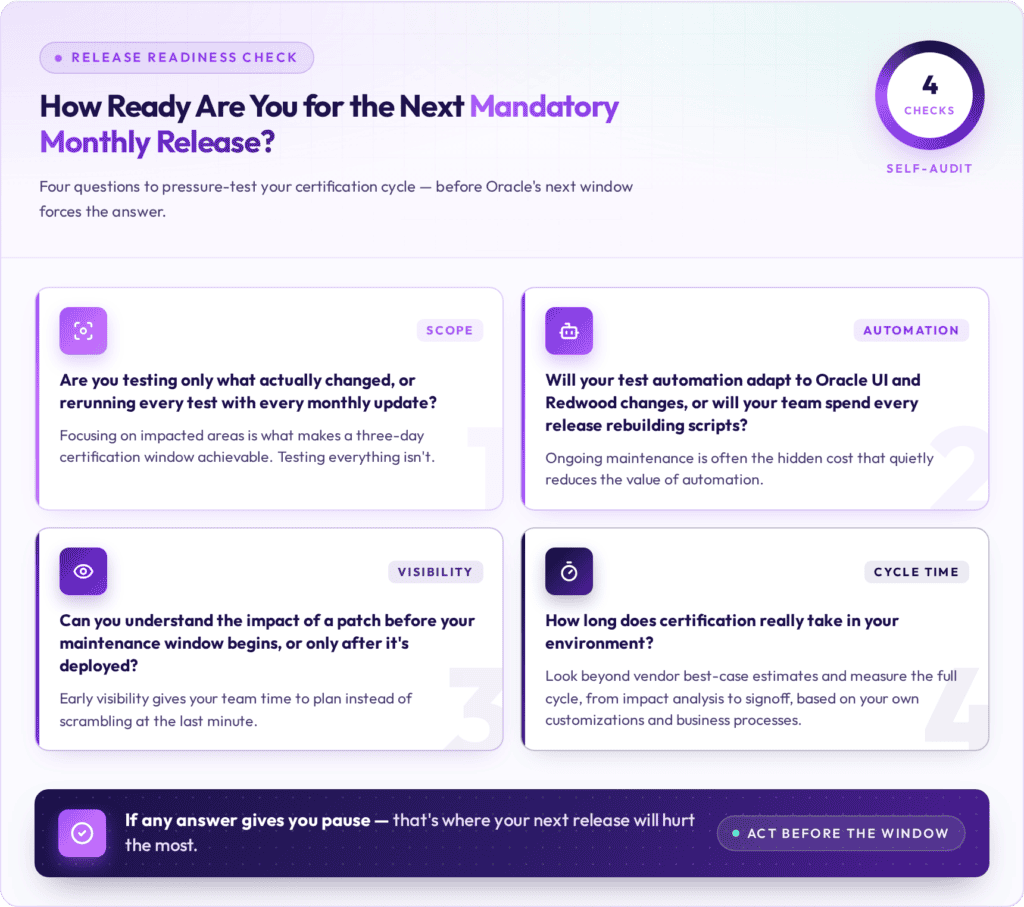
What to evaluate before your next cycle
Whether you’re considering building a solution in-house, expanding your team, or investing in a platform designed for this cadence, the same standard applies: it should be able to answer these questions with confidence.
Mandatory monthly maintenance isn’t a phase, it’s the new baseline, and it isn’t going away. Twelve-plus certification cycles a year, a fixed three-day window, and security patches that can still touch business logic add up to a standing resourcing and risk decision, not a one-time adjustment. Teams that build a scalable, repeatable process now turn twelve-plus cycles a year into a predictable, manageable rhythm instead of a growing resourcing problem.