Starting June 2026, Oracle made monthly maintenance mandatory for all Fusion Applications environments (ERP, HCM, SCM, CX, EPM) and added a new monthly Critical Security Patch Update (CSPU) cycle on top of the existing quarterly Critical Patch Updates.
Oracle’s first monthly CSPU, released in June 2026, shipped 245 patches, more than 100 of them for Oracle Fusion Middleware. That’s not a minor update. It’s a monthly event with real potential to touch business processes, and testing your specific environment is where the responsibility sits.
That’s a jump from roughly four change events a year to twelve or more, with only about three days between when non-production gets patched and when production follows. Most teams built their testing process for the old quarterly rhythm. Here we have mentioned five signs that the process won’t hold up, and what to check first.
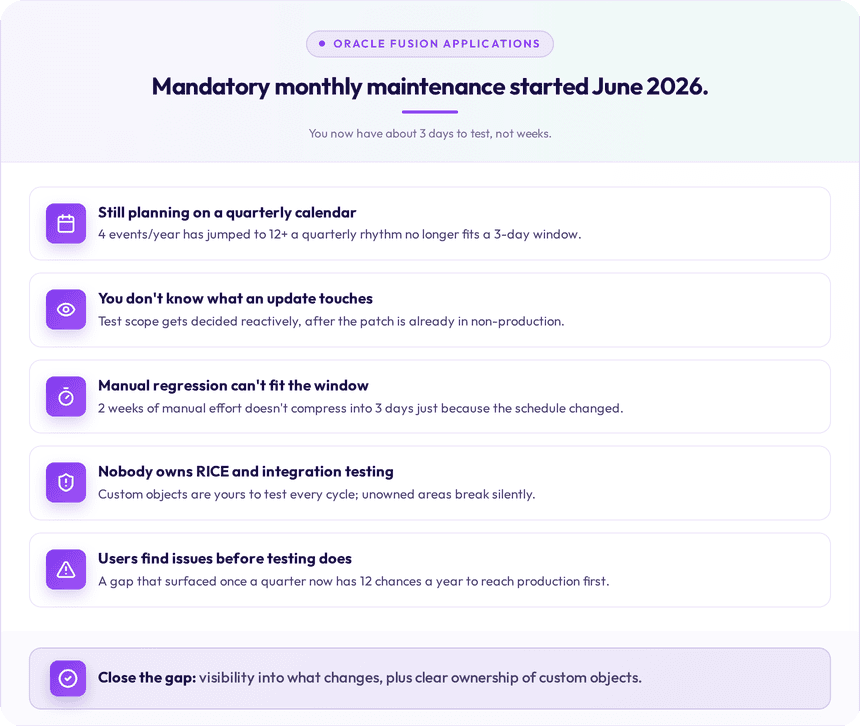
1. Your team still plans around a quarterly calendar
If your certification process has a rhythm built around four events a year, a planning meeting, a testing sprint, a change advisory board review before go-live, that rhythm no longer fits. Monthly maintenance doesn’t give you a multi-week runway. It gives you days. Teams that haven’t rebuilt their planning cadence tend to find out the hard way: the test-window plan written for quarterly patches doesn’t scale down to a monthly one, and testing quietly gets compressed, rushed, or skipped in the months it doesn’t fit the calendar.
Pull your last three patch cycles. If planning and kickoff took longer than your actual test execution, your process is still running on quarterly assumptions.
2. You don’t know what an update touches until something breaks
Oracle publishes what changed in each release at the platform level. Knowing what that means for your specific customizations, integrations, and business processes is a separate challenge, and most teams don’t have a reliable way to answer it before the patch arrives.
Testing scope gets decided reactively, after the update is already sitting in non-production, instead of proactively. By the time you know what’s actually at risk, part of your three-day window is already gone.
Ask your team how they currently decide what to test for a given monthly update. If the answer involves reading Oracle’s release notes and guessing, that’s the gap. If you want a clearer picture of what a specific update touches in your environment before committing test hours, Opkey’s Release Advisor Pro, launching in July, is built for exactly this kind of impact analysis.
3. Manual regression testing takes longer than your patch window allows
This is the math problem underneath everything else. If validating a quarterly patch took your team two weeks of manual effort, that effort doesn’t compress into three days just because the schedule changed. Something must give, and its usually coverage: teams under time pressure test the obvious business flows and hope the rest holds.
Time your last full manual regression cycle against your actual patch window. If the ratio is more than roughly 3:1, manual testing alone won’t keep pace with a monthly cadence.
4. Nobody clearly owns testing for RICE objects, integrations, and personalization
Oracle is explicit about this one: Your RICE components, OIC integrations, BI Publisher reports, and page personalizations are yours to test, every cycle.
At a quarterly cadence, this gap often got covered by generalist effort and enough lead time to catch problems late. At a monthly cadence, if no one is clearly assigned to validate these customized areas every single cycle, they become the parts of your environment most likely to break silently, and least likely to get caught before go-live.
Name the person or team responsible for RICE and integration testing on your last update. If you can’t name someone quickly, no one owns it.
5. You find out about issues from end users, not from testing
This is the sign that should worry you most. If patch-related issues typically surface as help desk tickets or broken workflows after go-live, rather than as test failures caught earlier, your testing process isn’t protecting production. It’s a formality. Monthly updates raise the stakes on this twelvefold: a gap that surfaced once a quarter now has twelve chances a year to reach your users first.
Look at your last two or three post-patch incident reports. If they trace back to something that should have been testable, your detection is happening in production instead of before it.
What this means going forward
Oracle’s shift to monthly updates isn’t arbitrary. Faster patching closes security exposure faster, which is the point. But it does mean a testing process designed for four events a year needs to be rebuilt for twelve or more: faster to execute, more targeted, and grounded in real visibility into what each update changes in your environment before testing starts.
That visibility gap, knowing what an update touches before the maintenance window opens, is where most teams get stuck first.
Curious where your process stands?
Opkey’s Release Advisor Pro gives Oracle teams advance visibility into what a monthly update will impact in their environment before the window opens.
Frequently Asked Questions
Oracle’s published schedule typically patches non-production mid-week and production over the following weekend, leaving about three days to validate between.
Usually the latter. The fix is rarely a full rebuild. Most teams just need to close two gaps: visibility into what an update changes, and clear ownership of custom objects your team is responsible for testing.
It’s meant to show, before a maintenance window opens, exactly what a given monthly update will touch in your specific environment, so testing starts from a narrow, known scope instead of a guess.
It depends on your environment’s complexity and customization volume. Teams with light customization and strong process discipline can sometimes hold a monthly window manually. Teams with heavier integration and RICE footprints typically tend to struggle with manual coverage at that pace.