Oracle Cloud SCM 26C is a major quarterly update across planning, procurement, inventory, orders, manufacturing, maintenance, and logistics, aimed at improving usability, planning accuracy, and execution efficiency. Teams get a short, defined window between test and production to decide which changes affect their workflows. Opkey’s 26C SCM Advisory and Release Advisor turn the full release notes into a focused, risk-based testing and change plan so you can see what matters, prioritize testing and automation, and protect supply chain continuity before the 26C go-live date.
Knowing what changed is only half of the battle. Building a repeatable process to test it every quarter is what actually protects your operations long-term. Get our eBook and learn how to build a faster, risk-based testing strategy for every Oracle Cloud release.
Big themes in Oracle Cloud SCM 26C
Oracle Cloud SCM continues to evolve as a unified, end-to-end supply chain platform, and 26C extends that direction with changes across Supply Chain Planning, Procurement, Inventory Management, Order Management, Manufacturing, Maintenance, Cost Management, Supply Chain Collaboration, Product Hub, and Warehouse Management.
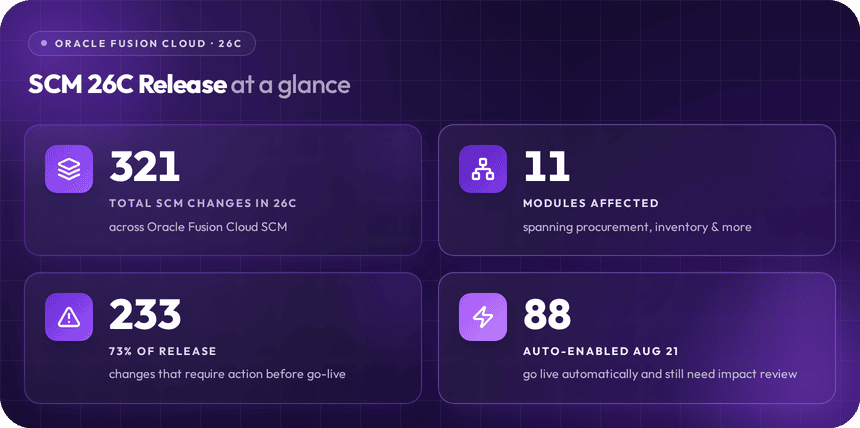
26C is a heavier release than 26B across every measure that counts. The prior cycle carried 299 total changes across 12 modules, with 200 requiring action and 99 going live automatically. 26C adds 22 more total changes, pushes action-required items from 200 to 233, and reduces auto-enabled from 99 to 88, meaning more of this cycle’s workload lands directly on your team rather than rolling out in the background. Teams that managed 26B manually will find 26C harder to triage on the same approach.
While Oracle’s official 26C release notes call out module-level updates, Opkey overlays an impact lens, highlighting which items affect planning logic, procurement contracts, inventory controls, shipping and fulfillment flows, and integration touchpoints. This matters especially for the 10 AI agent features, Redwood experiences, and execution diagnostics in this release, which often require targeted testing and training rather than just a configuration toggle.
The Critical Change You Cannot Miss
26C carries one Critical change across all 11 SCM modules: Capture Fiscal Documents for Intercompany Drop Shipments in Cost Management. This change requires configuration before go-live and has direct implications for how fiscal documents are captured and recorded in intercompany drop ship flows. Organizations running intercompany drop shipment processes must review their Cost Management configuration and validate this flow before August 21. It is the single highest-priority item in the release.
Stronger planning, inventory, and fulfillment controls
Several 26C updates directly affect how you plan, stock, and fulfill orders. Inventory Management carries the heaviest load in this release with 86 changes, the largest of any module, including new AI agents for inventory optimization, inbound goods, and warehouse operations, alongside Redwood UI updates for cycle counting, picking, and receiving. Supply Chain Planning adds 33 changes covering safety stock integration with inventory optimization plans, pegging data visibility, and new planning constraint options that alter how planned orders are generated and sequenced.
For supply planning, operations, and logistics teams, these are not optional reviews. Changes to planning tools, stocking logic, or warehouse workflows can alter decision-making and KPIs like fill rate and on-time delivery. In Opkey’s advisory, these items are tagged as high impact for regression testing and surfaced in “What To Do This Week” action cards so owners know they require attention before go-live.
Redwood UX and automation in supply chain execution
Oracle Cloud SCM 26C advances Redwood UX and automation across supply chain execution in ways that standard release notes typically understate. Procurement carries 74 changes in this cycle, a significant portion of which are Redwood UI updates covering contract fulfillment, supplier qualification, negotiation workflows, and buyer assignment rules. Order Management adds 58 changes including Redwood updates to transit time calculation, ship method scheduling, and configure-to-order diagnostics, alongside six new AI agents covering claim settlement, order exceptions, sales order correction, and dock scheduling.
These updates may not always change configuration dramatically, but they can significantly alter how day-to-day work is executed on the shop floor, in the warehouse, and in control towers. In the advisory, Opkey flags these Redwood and automation updates with pre-assigned testing and communication priorities, so teams can see where UX changes will affect SOPs, training, and change management before go-live.
Risk, compliance, and contract governance
For procurement, quality, and audit teams, 26C introduces changes that affect contractual controls and auditability. Procurement carries a Contract Compliance Workspace, contract collaboration via Microsoft SharePoint, and restricted party screening enhancements, all flagged as High severity and requiring configuration. Supply Chain Collaboration adds 19 changes including GTM restricted party pre-processing and automation agent actions for shipment tendering, which affect how outbound shipments are authorized and tracked.
Why SCM 26C is hard to digest manually
Oracle’s quarterly release model means SCM customers process four waves of change each year, with preview and production dates tightly scheduled and a standard testing window. For 26C, preview opens July 8 and production goes live August 21. That window covers 321 changes across 11 modules, with 233 requiring action and 88 going live whether your team is ready or not.
Each change differs in how it is enabled, what it touches, and how much regression is needed versus a spot check or monitoring. 45% of 26C changes require setup, 11% carry potential setup requirements, and 8% combine opt-in with a service request. When teams try to manually sort through this distribution to find the Critical item, isolate the 184 High items needing regression, and track the 10 opt-in windows closing permanently at go-live, they lose critical days in an already short testing window.
What Opkey’s 26C SCM Advisory adds
Opkey’s Oracle Cloud SCM 26C Advisory sits between Oracle’s official “What’s New” documentation and your internal planning, turning release notes into an impact, ownership, and testing lens. In a single dashboard-style PDF organized by team rather than module, it gives teams:
- Executive Snapshot: 321 total changes, 233 requiring action, 88 auto-enabled, and 10 AI and agentic features requiring leadership sign-off.
- Testing Priority: 1 Critical plus 184 High items flagged for full regression; 184 High plus 135 Medium for spot check; 135 Medium and 1 Low for monitor only.
- What To Do This Week by Role: Action cards for IT and System Admin, Supply Chain and Operations, with items tagged by module and enablement type.
- Impact by Module: Change volume and severity across all 11 SCM modules so each team sees only their slice.
- AI and Agentic Features: 10 new agent capabilities including the Inventory Optimization Advisor, Planning Order Release Assistant, Inbound Goods Advisor, and Sales Order Command Center, all flagged separately because they require leadership sign-off and change management planning, not just a configuration ticket.
- Opt-In Expiry: 10 features with windows that close permanently on August 21, covering Inventory Management, Manufacturing, Procurement, Maintenance, Supply Chain Planning, and Cost Management.
- Enablement Breakdown: 45% setup required, 27% no action needed, 11% potential setup, 8% opt-in plus service request.
- The advisory is available free at opkey.com. Opkey updates its release tracking in sync with Oracle’s readiness publications so the data reflects the current published state of 26C
How to use this for 26C planning
Start by downloading Opkey’s Oracle Cloud SCM 26C Advisory and reviewing the Executive Snapshot with supply chain, operations, procurement, and IT leads, with immediate attention to the one Critical change in Cost Management for intercompany drop shipments. Use the “What To Do This Week by Role” section to assign owners across Supply Chain and Operations and IT and System Admin, with the 10 opt-in expiry items given their own deadline tracking before August 21.
Then open Opkey Release Advisor at opkey.com/release-advisor and use the prompt guide to explore 26C by module, enablement type, or test level. The Advisor has full context on all 321 changes and can build a targeted test plan, surface which Redwood changes affect your buyers or warehouse staff and identify configuration steps needed by module. The advisory is the map. The Advisor is the navigation.
26C is a bigger release than 26B, with 233 action-required changes, one Critical compliance item in Cost Management, 10 AI agents requiring leadership decisions, and 10 opt-in windows closing permanently on August 21. The teams that come out ahead are the ones who assign ownership now rather than the week before go-live.
Download the free SCM 26C Advisory to cut your triage time and build a testing plan your whole team can act on before the window closes.
Frequently Asked Questions
26C is Oracle’s third quarterly SCM release of 2026, covering 321 changes across 11 modules including Inventory Management, Procurement, Manufacturing, Order Management, Supply Chain Planning, and more. It is part of Oracle’s standard A/B/C/D annual cadence.
For Oracle Cloud Applications (SaaS), Release 26C goes live in production on August 21, 2026. The preview window (which allows testing in your test/sandbox environments) opens two weeks prior, on August 7, 2026
Auto-enabled changes go live on August 21 with no action required from your team but still need impact review because they can alter planning logic, fulfillment flows, and warehouse behavior. 26C has 88 auto-enabled changes. Opt-in changes require a deliberate setup step or service request before they activate. Ten opt-in features have windows that close permanently at production go-live on August 21, after which the choice to adopt them on your own timeline is gone.
The Critical change, Capture Fiscal Documents for Intercompany Drop Shipments, requires configuration before go-live. If it is not addressed, intercompany drop shipment fiscal document capture will not function correctly after August 21, creating cost accounting and compliance exposure in cross-entity transactions.
Yes. The advisory is available free at opkey.com. Opkey Release Advisor, the interactive tool for querying all 321 changes by module, severity, and role, is also available without a paid subscription to get started.