Oracle Cloud Financials 26C is a major release with 137 changes across 12 modules, going live in production on August 21, 2026, whether you act on them or not. For finance and IT teams, the main work is deciding which changes need attention, testing, and change management before that date, instead of reading long release notes.
Opkey Release Advisor helps you do that by turning the full 26C change list into a clear, impact-based testing plan for your own environment. You get a direct view of which updates affect your configurations, integrations, and business processes, and what to test and when.
Key themes in Oracle Cloud Financials 26C
Oracle Cloud Financials remains the core for global finance operations, and 26C continues that path with changes across Payables, Receivables, Project Financial Management, Tax, Fixed Assets, Cash Management, Risk Management, and cross-functional workflows.
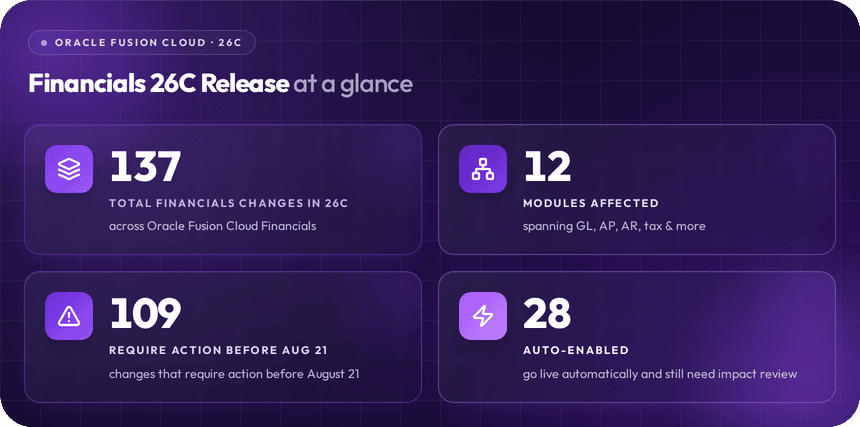
Opkey’s advisory snapshot breaks this down into four numbers worth holding onto for the rest of this article.
Across Financials, HCM, and SCM together, Opkey’s dashboard tracks more than 700 changes for 26C. Finance, HCM, and SCM teams each get their own view rather than one long shared list.
Compliance priorities: Poland and Brazil
26C carries high compliance urgency in Financials. All three Critical changes are legislative mandates for Poland and Brazil, all three are auto-enabled on August 21, and all three require configuration before go-live. They are not optional.
1. JPK Audit File Reporting Update (Poland)
Oracle has updated the JPK_V7M structure to align with the latest Polish Ministry of Finance requirements. Organizations filing JPK audit reports must reconfigure their reporting setup to match the new schema before go-live. Submitting under the old structure after August 21 will produce non-compliant filings.
2. Polish VAT Declaration Alignment (Poland)
The VAT declaration workflow inside Oracle Tax has been updated to reflect Poland’s current regulatory format. Finance and Tax teams running Polish VAT processes need to validate their tax configuration, review period-end outputs, and confirm the updated declaration template is correctly mapped to their legal entity setup.
3. Brazilian Fiscal Document Workflow Update (Brazil)
Oracle has updated the electronic fiscal document (NF-e/NFS-e) processing workflow to reflect current SEFAZ requirements. Organizations issuing or receiving fiscal documents in Brazil must review their fiscal document configuration and test end-to-end document flows before August 21 to avoid processing failures at go-live.
In Opkey’s advisory, these three changes sit in a separate Critical Compliance Alert section so they cannot be lost under routine updates.
Automation and New Finance Features
26C brings a new set of agent-style features into Financials, including Fixed Assets, Payables, Project Financial Management, and cross-functional workflows. These capabilities are treated separately in the advisory because they usually need leadership review and structured change management, not just IT setup. Enabling a new agent in a live finance process is a different decision than turning on a new report or field.
Risk and configuration workload
With 109 of 137 Financials changes requiring action and 28 going live automatically on August 21, the configuration and testing workload is heavy for this cycle. Spread across 12 modules; this volume makes manual triage hard. Teams need clear direction on which items are urgent, which are configuration only, and which need cross functional sign off.
Why 26C is hard to manage by hand
Oracle’s quarterly update model gives Financials customers four releases a year, each with its own preview and production timeline and a standard testing window. For 26C, Opkey’s advisory maps Financials changes across 12 modules and tracks them alongside 84 HCM changes and 88 SCM changes that share the same August 21 release date.
Each change differs in how it is enabled, what it touches, and how much testing is needed. Manually sorting 137 Financials items to find the 109 that need action, understand what the 28 auto enabled items might affect, and locate compliance risk in Poland and Brazil is where teams lose time and control.
What Opkey’s Oracle 26C Release Advisory offers
Opkey’s Oracle Cloud 26C Advisory collects all module specific updates across Financials, HCM, and SCM and organizes them into one dashboard, so each functional team can go straight to the changes that matter to them.
The dashboard includes:
- Executive Snapshot: Four key metrics on total changes, changes that need action, auto enabled items, and new agent style features.
- Critical Compliance Alert: Legislative changes that go live automatically on August 21, including the Poland and Brazil mandates.
- Testing Priority: Every change tagged as full regression, spot check, or monitor only, so QA planning does not start from a blank sheet.
- What To Do This Week by Role: Action cards for Finance and Tax, IT, Payables, and Project and Receivables, each with owned changes and timelines.
- Impact by Module: Visual breakdown of change volume and severity across all 12 Financials modules.
- Agent Features: New agent capabilities highlighted separately to support leadership review.
- Opt In Expiry: Features with closing windows that become permanent after August 21.
- Enablement Breakdown: Summary of what is auto enabled versus what needs setup, opt in, or a service request.
- Prompt Guide: Ready questions for Opkey Release Advisor, organized by role.
Why 26C matters and how to use this
Why 26C Matters
Oracle 26C is a heavier release than 26B by every action-required measure: total changes are up from 129 to 137, action-required items climbed from 91 to 109, and auto-enabled changes dropped from 38 to 28, meaning more of this cycle’s workload lands directly on your team rather than rolling out automatically.
That scale does not need to become a fire drill. A practical plan starts by downloading Opkey’s Oracle Cloud 26C Advisory and reviewing the Executive Snapshot with finance and IT leaders, with direct attention to the Critical Compliance Alert if you operate in Poland or Brazil. From there, use the “What To Do This Week by Role” section to assign owners across Finance and Tax, IT, Payables, and Project and Receivables.
Then open Opkey Release Advisor at opkey.com/release-advisor and use the prompt guide to explore 26C by module, severity, enablement type, or test level. This helps you build a focused test and change plan, with full regression on the three Critical and other high-priority items, and spot checks or monitoring for the rest.
26C is not a light release. Between the three compliance mandates, 109 action-required changes, and new agent-style features landing across Financials on the same August 21 date, the teams that come out ahead will be the ones who start triaging now rather than the week before go-live.
Download the free 26C Advisory and Readiness Checklist to see exactly what your team needs to act on before August 21.
Frequently Asked Questions
26C is Oracle’s third quarterly Financials release of 2026, covering updates across 12 modules including Payables, Receivables, Tax, Fixed Assets, and Project Financial Management. It is part of Oracle’s standard A/B/C/D annual cadence.
August 21, 2026. Preview environments are available earlier for testing. Oracle’s standard testing window runs from the preview date through production go-live.
Auto-enabled changes go live on August 21 with no action required from your team, but they still need impact review because they can alter existing workflows. Opt-in changes require a deliberate setup step, configuration update, or service request before they activate. 26C includes 28 auto-enabled Financials changes and a larger set of opt-in items, some of which have expiry windows that close permanently at go-live.
For the three Critical legislative changes covering Poland and Brazil, missing the go-live date means your JPK filings, VAT declarations, or Brazilian fiscal document workflows will operate on an outdated configuration. That creates direct compliance exposure. These are auto-enabled, so the Oracle system will update regardless. The risk is that your setup does not align with the new structure.
Yes. The advisory is free at opkey.com. Opkey Release Advisor, the interactive tool for exploring changes by module and role, is also available without a paid subscription to get started.