Enterprise applications rarely fail in isolation.
A pricing rule updated in one module can throw off tax calculations in another. A routine security patch can quietly change how an approval workflow behaves. None of these failures show up in the release notes. They show up weeks later, in a finance report that does not reconcile or a customer order that gets stuck.
This is the environment every enterprise operates in now: systems that are deeply connected, changing constantly, and rarely tested as thoroughly as the risk deserves. Most teams know this. Fewer have a reliable way to catch these issues before they reach production.
That gap is exactly what disciplined testing is meant to close. This is why quality assurance testing tools deserve a seat in risk management conversations.
Why Risk Management and QA Are Really the Same Conversation
Risk management asks a simple question: what could go wrong, and how do we prepare for it? Quality assurance answers that question in practice.
Every test case is really a small risk assessment. It asks whether a process will behave as expected under real conditions, and if not, what breaks and how it impacts.
When testing is treated as a separate, later-stage activity, risk management becomes reactive. Problems get caught after they affect users, transactions, or reports. When testing is built into the change process from the start, risk management becomes proactive. Issues are caught before they reach production, when they are cheaper and easier to fix.
The Real Cost of Skipping Rigorous Testing
Enterprise applications are complex. They involve interconnected modules, third-party integrations, custom workflows, and years of configuration built over time. A single overlooked dependency can cause:
- Financial errors that affect reporting accuracy or compliance obligations
- Broken integrations between core systems and surrounding applications
- Downtime during business-critical periods like month-end close or peak season
- Data integrity issues that undermine trust in reports and dashboards
- Poor user adoption when new features or workflows do not work as promised
None of these are hypothetical. They are common outcomes when testing is rushed, manual, or incomplete. And they are precisely the outcomes that structured quality assurance testing tools are designed to prevent.
What Good Quality Assurance Testing Tools Actually Do for Risk Management
Modern QA tools go beyond simply checking whether a button works. When applied well, they support risk management in several concrete ways.
They widen test coverage. Manual testing teams can only cover so much ground in a limited time window. Automated testing tools can run far more test cases across more scenarios, including edge cases that are easy to miss under manual review.
They catch regressions early. Every change to a system has the potential to break up something that is used to work. Automated regression testing checks existing functionality every time a change is made, so old problems do not resurface disguise as new features.
They support continuous testing. Instead of testing only before a major release, teams can test continuously as changes happen. This shortens the gap between when a defect is introduced and when it is discovered, which is one of the most effective ways to reduce risk.
They create audit trails. For regulated industries, documented, repeatable test evidence is not optional. Good QA tools generate that evidence automatically, which supports both compliance and internal governance.
They help prioritize risk-based testing. Not every process carries equal risk. QA tools that support risk-based test planning help teams focus effort on the workflows that matter most to the business, such as revenue-impacting or compliance-sensitive processes, rather than spreading effort evenly across everything.
Building a Risk-Aware Testing Strategy
Tools alone do not manage risk. They need to sit inside a thoughtful strategy. A few principles help:
- Start with impact, not convenience. Identify the business processes where failure would cause the most damage, and test those first and most thoroughly.
- Treat test cases as living documentation. As systems evolve, test cases should evolve with them. Outdated test cases give a false sense of security.
- Involve business users, not just IT. The people who run daily operations often understand risk in ways that technical teams do not. Their input makes test coverage more realistic.
- Measure what matters. Track metrics like defect escape rate, test coverage percentage, and time to detect issues. These numbers tell you whether your QA process is actually reducing risk or just creating activity.
- Make testing repeatable. One-off testing efforts help once. Repeatable, automated testing helps every time a system changes, which is what real risk management requires over time.
Where Opkey Fits In
Opkey approaches quality assurance as a continuous, business-aligned practice rather than a one-time checkpoint. Instead of relying purely on manual scripts or fragile, hard-to-maintain automation, Opkey helps teams build test coverage that mirrors real business processes and adapts as those processes change. This makes it easier to catch risk early, keep pace with frequent system updates, and give both IT and business stakeholders confidence that critical workflows are protected.
Risk management does not stop test coverage. It also depends on how safely your data is handled while testing happens. Opkey is built as an enterprise-grade test automation solution with encrypted in-flight data storage, and it is designed to fit into your existing infrastructure, whether that is on-premises or in the cloud.
Data protection is treated as a core responsibility, not an afterthought. Opkey’s practices are assessed and certified by independent third-party auditors against a wide range of recognized standards, including:
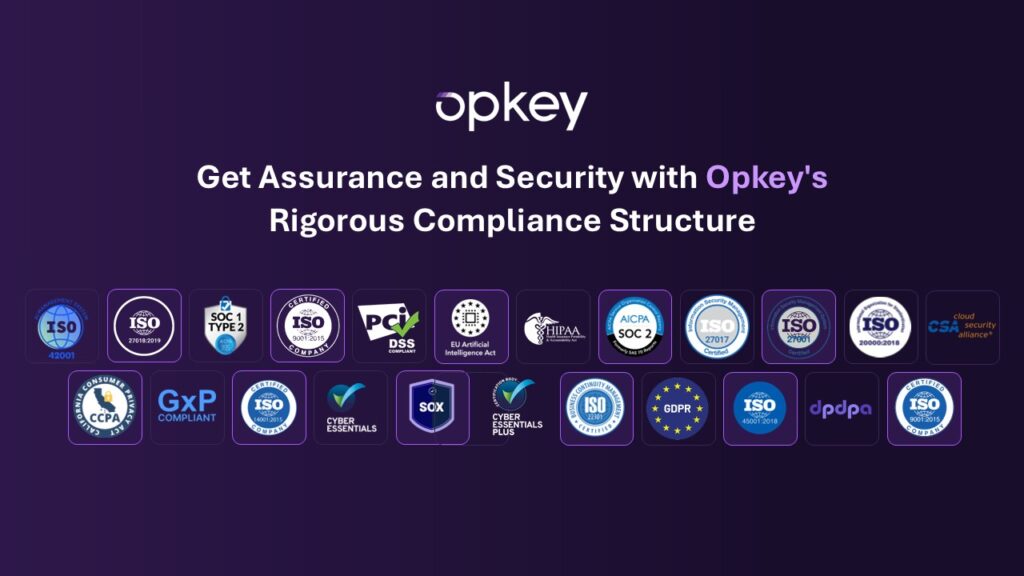
For enterprises operating under strict regulatory obligations, this matters as much as functional test coverage does. A testing solution that cannot be trusted with sensitive data introduces its own risk, no matter how thorough its test cases are. Opkey’s approach is to close that gap so that testing strengthens both operational reliability and data security at the same time.
The goal is not testing for its own sake. It is testing as a genuine risk management tool, one that protects revenue, compliance, and user trust all at once.
Final Thought
Risk in enterprise systems is not something you eliminate. It is something you manage well or manage poorly. The organizations that manage it well treat quality assurance testing tools as part of their risk strategy, not as a technical afterthought. That shift in mindset, more than any single tool, is what separates smooth system changes from costly surprises.