
If you manage an Oracle Cloud environment, you’ve felt the shift. What used to be four predictable release events a year has turned into a near-constant stream of change. Since June 2026, Oracle’s mandatory monthly maintenance and monthly Critical Security Patch Updates run on top of the existing quarterly release cycle, taking teams from about four validation events a year to 12 or more. That’s a security-forward move on Oracle’s part. Faster patching closes known vulnerabilities faster. But it also means your team now owns testing and validation on a monthly clock instead of a quarterly one, and the maintenance windows that come with it can’t be postponed.
For IT Directors, QA leads, and the application owners who live inside these environments every day, that’s not a small adjustment. It’s a fundamentally different workload.
The real challenge isn’t Oracle’s pace. It’s knowing what applies to you.
Every Oracle release, whether it’s a full quarterly update or a monthly patch, touches dozens or hundreds of features across modules, regions, and severities. Somewhere in that list are a handful of changes that actually intersect with your environment: your customizations, your integrations, your configured business processes. Finding those few changes inside a release note that can run 90-plus pages is where most of the time goes.
Traditionally, that meant one of two things.
- Either your team reads through the entire release manually and tries to guess what’s relevant, which eats days before testing even starts,
- Or you default to blanket regression testing everything, just to be safe, which eats weeks.
Neither approach scales at 12-plus validation cycles a year. And every hour spent re-reading documentation or re-testing features that didn’t change is an hour not spent on the parts of the release that actually matter to your business.
This is the exact gap Opkey Release Advisor was built to close.
Meet Opkey Release Advisor
Release Advisor is Opkey’s release readiness solution, and it comes in two tiers, Lite and Pro, that share the same underlying intelligence. At its fullest depth: Release Advisor Pro tells IT Directors, QA leads, and application owners which release changes affect their specific environment, what to configure, test, and train on, so their teams can certify releases in days, not weeks.
At the center of it is Argus AI, Opkey’s proprietary large language model built specifically to understand the Oracle ecosystem. Argus AI reads Oracle’s release notes as they publish, scans Oracle’s website for additional context, and draws on insights from Opkey’s broader customer and partner network. It then maps every change against your live configurations, integrations, and customizations, so you see exactly where a release lands in your world, not just what changed in general. That mapping is what turns a release note into a plan.
Lite or Pro: one engine, two depths
Both tiers of Release Advisor run on the same Argus AI engine, so the question isn’t which AI you’re getting. It’s how deep you need the analysis to go.
- Release Advisor Lite reads every Oracle release the moment it ships and turns it into a plain-language summary, organized by module and severity. It’s built for teams that want visibility into Oracle’s pace without spending time in Oracle’s own documentation, and it includes the same unlimited natural-language queries through Ask Argus. Lite is free to access, so your team gets the same information without digging through Oracle’s release notes directly.
- Release Advisor Pro takes that same release and maps it against your live modules, integrations, customizations, and business processes, then generates the targeted test plan and hands off configuration and training work. It’s built for teams managing a customized environment who need to know what a release means for them specifically, not just what changed in general.
If you’re weighing which one fits, the honest answer usually comes down to whether your Oracle environment carries meaningful customization. If it does, that’s where Pro’s environment-specific mapping earns its keep.
What that looks like day to day
Release Advisor Pro brings together three connected pieces:
- The Release Dashboard gives your team a complete view of every Oracle release, quarterly or monthly, with changes organized by module, severity, and region. Critical impacts are highlighted so nothing important gets buried, and a complete audit trail sits behind every release for compliance and historical comparison. It also tracks the optional weekly bundles some organizations request for hot fixes, showing what to test for each bundle and how it rolls up into the full monthly release.
- Ask Argus lets anyone on the team ask questions in plain language instead of digging through pages of release documentation. Query volume is unlimited, and answers come back as module-specific summaries with test case recommendations already attached. Work that used to take days of reading now takes minutes.
- Impact Analysis, available with Pro, is where the environment-specific intelligence lives. Each release is mapped directly to your live modules, integrations, and customizations, and a tailored test plan is generated from that mapping. Instead of your team guessing what applies, they start from a plan that was built specifically for their environment, with configure, test, and train decisions already worked out.
What that means for the people managing releases
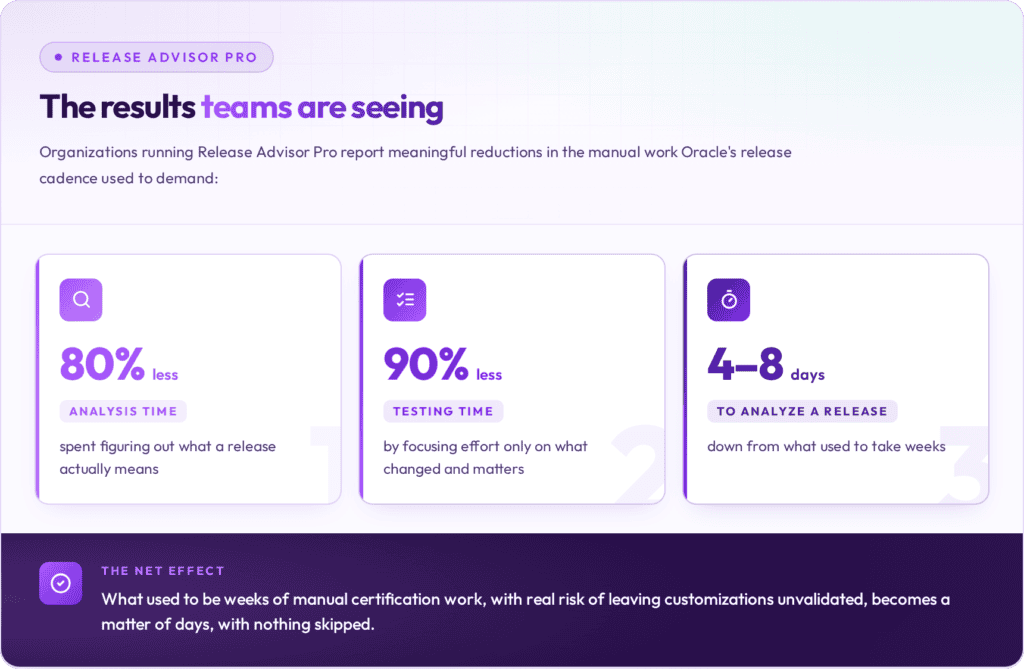
For a VP of Applications or IT Director, the operational burden of monthly cycles turns into visibility: your team knows what every release touches in your environment before it touches production, and certification timelines move from weeks to days.
For a QA lead whose test library was built around quarterly cycles, it means targeted test plans generated automatically for every release, mapped to your existing automation, with no need to rebuild your library from scratch to keep up with a monthly pace.
For the Oracle apps owner or technical admin who validates that nothing broke after every release, now 12 or more times a year, it means automated, environment-specific impact analysis after every update, so gaps surface before testing even begins rather than after something ships.
Beyond Oracle
Release Advisor Pro is built specifically for Oracle Cloud, and that focus is what makes its Oracle-specific intelligence possible. If Workday is also part of your landscape, a dedicated Workday Release Advisor is coming soon, bringing the same environment-specific approach to Workday’s release rhythm.
Every Oracle release, made routine
Oracle’s move to monthly updates isn’t going away, and it’s a reasonable response to a real security need. The organizations that adjust well won’t be the ones working harder to keep up. They’ll be the ones who know, the moment a release ships, exactly what it means for their environment and exactly what to do about it.
That’s what Release Advisor Pro is built for: turning every Oracle release, whether it’s the big quarterly update or this month’s patch, into something your team can read, plan for, and certify with confidence, in days instead of weeks.