In Q1 of this year, we surveyed over 200 IT leaders. In light of daily news about massive tech layoffs, one of the most interesting (and optimistic) findings was that IT leaders plan to reinvest freed resources from automating the enterprise application lifecycle primarily into employee experience, innovation, higher‑value work, and backlog reduction, rather than simply cutting costs.
Invest in Growth, experience and innovation
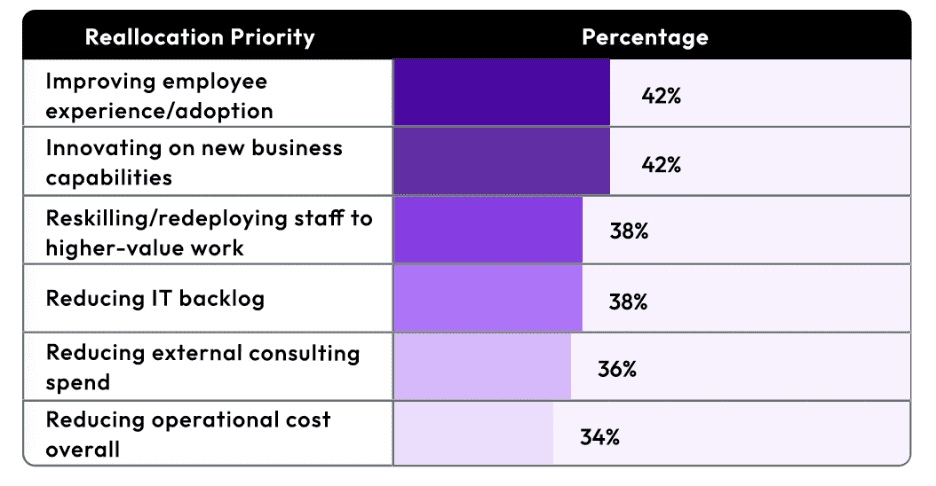
When asked how they would use hours and budget saved by automating and optimizing the management of their enterprise apps agentic AI, respondents most often chose growth, experience and innovation-oriented outcomes.
The data suggests a clear and healthy path to growth and innovation.
- First, leaders want to reinvest in people: improving employee experience and adoption is a top outcome overall for their IT organization, and it’s also the most selected use of freed capacity. This ties directly to training, change management, and smoother rollouts.
- Second, there is a strong push toward innovation: roughly two in five plan to channel savings into new digital products, features, or capabilities, especially in finance, manufacturing, and retail.
- Third, teams see automation as a way to change the nature of IT work, not just its volume, by reskilling and moving staff away from manual configuration, testing, and firefighting into analysis, design, and continuous improvement.
- Fourth, a significant share will finally tackle the IT backlog that has built up under the pressure of frequent cloud releases and limited headcount, using freed hours to retire technical debt and deliver long‑delayed enhancements.
Cost‑cutting is still on the list, but it sits behind these growth and experience oriented moves. Reducing reliance on external SIs and consultants comes ahead of broad operational cost cuts, which aligns with other findings that many see current SI usage as something they plan to significantly reduce.
Implications for your roadmap
Taken together, these findings tell a strategic story: agentic AI‑driven automation is not just about “doing the same with less,” it is about freeing up capacity to do different, higher‑impact work.
IT leaders are effectively saying: Let AI handle regression testing, impact analysis, and repetitive support tickets, and let our people focus on adoption, process redesign, analytics, and new capabilities.
In a climate where you may be under pressure to reduce headcount, this gives you a powerful alternative narrative: protect your experts, change the work. If you are planning your own AI or automation roadmap around enterprise applications, be sure to:
- Frame your business case around reallocation, not only savings. Be explicit about how many hours you expect to move into employee enablement, product innovation, or backlog burn‑down.
- Involve both IT and business stakeholders early, because the top uses of freed capacity are cross‑functional: adoption, experience, and new capabilities all require tight partnership.
- Plan for reskilling as a first‑class workstream, not an afterthought, since over a third of leaders expect to redeploy people into higher‑value roles as automation ramps.
How Opkey helps you operationalize this shift
IT operations are under pressure, but the fastest path out is to automate the right parts of the lifecycle and reinvest the capacity you unlock.
Opkey was built for exactly this moment. Across the lifecycle, Opkey automates key tasks, including:
- Testing: with 30,000+ self‑configuring test scripts that replace slow, labor‑heavy regression cycles with AI‑generated coverage, increasing coverage and shrinking patch testing from weeks to days.
- Configuration: by automating change detection, impact analysis, and migration so you can ship more, break less, and stop relying on late‑night heroics.
- Training Documentation: by automatically delivering role‑based, in‑app guidance that lifts adoption and turns every release into an opportunity to build capability, not confusion.
All of this is orchestrated by Argus AI, Opkey’s ERP‑native small language model designed to understand configuration, process, and change in context.
The result is simple but powerful: you reduce cost and risk, and you get a choice about what to do with the time and money you get back.
Our research tells us what high‑performing leaders are choosing:
- Invest in people and experience.
- Fund new capabilities.
- Upgrade skills instead of cutting heads.
- Finally tackle the work that has been stuck on “someday.”
If you’re being asked to cut, but you’d rather reallocate, now is the moment to put a data‑backed plan on the table.