Oracle Cloud HCM 26C is a significant quarterly update across recruiting, payroll, performance management, core HR, learning, absence management, time and labor, compensation, benefits, and workforce scheduling, with changes that affect not just how HR teams configure Oracle but how employees and managers experience it every day. Teams get a short, defined window between preview and production to identify which changes need configuration, which go live automatically, and which require communication plans before they land on the workforce.
Opkey’s 26C HCM Advisory and Release Advisor turn the full release notes into a focused, risk-based testing and change plan so HR, Payroll, and IT leads can see what matters, assign ownership, and protect workforce operations before the August 21 go-live date.
Knowing what changed is only half of the battle. Building a repeatable process to test it every quarter is what actually protects your operations long-term. Get our eBook and learn how to build a faster, risk-based testing strategy for every Oracle Cloud release.
Big Themes in Oracle Cloud HCM 26C
Oracle Cloud HCM continues to advance as an integrated workforce platform, and 26C extends that direction with changes spanning across the HCM ecosystem.
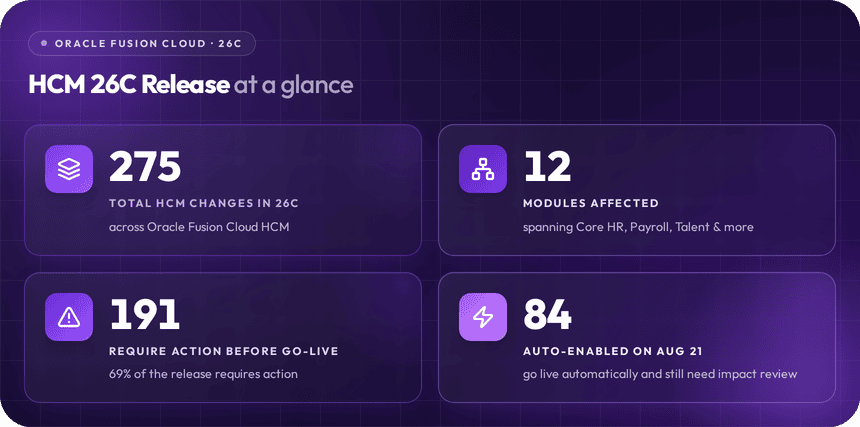
Unlike SCM 26C, which carries one Critical change, HCM 26C has zero Critical items. That does not reduce the workload. With 79 High-priority changes requiring full regression and 191 items total needing action, the testing and communication burden is substantial, particularly because a significant portion of HCM changes affect the employee and manager experience directly, not just backend configuration. Changes that alter how people submit absences, view payslips, complete onboarding tasks, or navigate Redwood workflows require communication plans alongside config work, and that distinction is built into how Opkey’s advisory organizes the release.
While Oracle’s official 26C release notes call out module-level updates, Opkey overlays an impact lens that highlights which items affect payroll compliance, talent workflows, employee-facing experiences, and integration touchpoints. This matters especially for the 10 AI and agentic features in this release, which require leadership sign-off and change management planning and must not be treated as standard opt-ins.
Recruiting and Talent: The Heaviest Module in 26C
Recruiting leads HCM 26C with 67 changes; AI-assisted onboarding and outreach, activity centers, intelligent talent search, and major Redwood UX updates for interviews, offers, bulk candidate actions, and pipeline requisitions. Performance Management adds 41 changes, including six AI agent features for promotions, change-assignment workflows, succession planning, talent calibration, and broad Redwood updates to performance documents, talent reviews, and career development.
These are functional, not cosmetic: updates to recruiting workflows, offer‑letter versioning, candidate selection, and performance‑document flows will change daily interactions for hiring managers and employees. Opkey flags these items with testing and communication priorities in “What To Do This Week” cards so recruiting and talent owners know which need regression testing and employee-facing messaging before go‑live.
Payroll Compliance and Country-Specific Updates
Payroll includes 39 changes in 26C, many of them country-specific compliance updates that require configuration before August 21. These cover Carer’s Leave, Domestic Violence Leave and Payment, PRSI Exemption Changes, and Ireland NAERSA Contribution Submission for UK and Ireland; LGPS Stringer Days, P45 Document Type, and Real Time Information encryption updates; Bahrain Unemployment Insurance; and India updates to TDS Challan Mapping and Investment Declaration.
Three High-severity Global Payroll Interface V2 and ADP baseline extractions are auto-enabled, meaning they go live on August 21 regardless of review. For global organizations, the combination of auto-enabled baseline extractions and legislative changes makes Payroll one of the highest-risk modules in 26C. Opkey’s advisory organizes Payroll updates by country and enablement type, allowing admins to quickly focus on the changes relevant to their jurisdictions.
People-Facing Changes That Require Communication Plans
Unlike other Oracle product families, HCM 26C stands out for the sheer number of changes affecting how employees and managers interact directly with Oracle. Cross-Functional brings 35 changes, such as Agent as Task Performer in Journeys, AI Recommendations for Key Communications, Express Communication Teams, and Redwood-Slack integration, that reshape daily user experience. Core HR adds 29 changes, including Redwood enabled by default across Employment, Person, and Workforce Structure Pages, plus AI-assisted job and position management.
While these updates may not require complex configuration, they can substantially change how HR specialists, managers, and employees navigate Oracle after August 21. Failing to communicate these changes before go-live risks confusion, higher HR Help Desk volume, and lost productivity gains. Opkey’s advisory separates people-facing changes from backend configuration items, helping HR and communications leads identify what needs a communication plan versus just a config ticket.
Why HCM 26C Is Hard to Digest Manually
- 275 changes across 12 HCM modules in Oracle 26C.
- 191 changes require action; 84 are auto enabled at production.
- Preview: August 8 | Production: August 21, leaving a short testing window.
- Compared to Oracle HCM 26B, 26C has more total changes (275 vs. 268) and more auto-enabled updates (84 vs. 66).
- No Critical items in 26C, but 84 background changes increase deployment risk.
- Auto-enabled updates impact Recruiting, Payroll, Redwood UX, and integrations.
- Changes vary by enablement type (auto-enabled, opt-in, configuration), business impact, and testing requirements.
- 51% require setup, 16% may require setup, and 3% require both opt-in and a service request.
- 79 High-priority changes require regression testing.
- HR, Payroll, and IT teams must identify configuration needs, people-facing changes, testing scope, and expiring opt-ins, making manual review slow and error-prone within the limited release window.
What Opkey’s 26C HCM Advisory Offers
Opkey’s Oracle Cloud HCM 26C Advisory sits between Oracle’s official “What’s New” documentation and your internal planning, turning release notes into an impact, ownership, and testing lens. In a single dashboard-style PDF organized by team rather than module, it gives HR, Payroll, Talent, and IT leads:
- Executive Snapshot: 275 total changes, 191 requiring action, 84 auto-enabled, and 10 AI and agentic features requiring leadership sign-off.
- Testing Priority: 79 High items flagged for full regression; 79 High plus 196 Medium for spot check; 196 Medium for monitor only.
- What To Do This Week by Role: Action cards for IT and System Admin (before preview) and HR and Workforce (standard review), with items tagged by module, enablement type, and whether they affect employees directly.
- Impact by Module: Change volume and severity across all 12 HCM modules, so each team sees only their slice without reading through the full catalog.
- AI and Agentic Features: 10 new agent capabilities including the Employee Goals Assistant, Payroll Run Analyst, AI-assisted onboarding, Benefits Analyst Agent, and Talent Calibration Workspace, all flagged separately because they require change management planning, user training, and leadership sign-off.
- Opt-In Expiry: Features with windows closing permanently on August 21 that require action before go-live or the choice is gone.
- Enablement Breakdown: 51% setup required, 31% no action needed, 16% potential setup, 3% opt-in plus service request.
The advisory is available free at opkey.com. Opkey updates its release tracking in sync with Oracle’s readiness publications, so the data reflects the current published state of 26C.
How to Use This for 26C Planning
Start by downloading Opkey’s Oracle Cloud HCM 26C Advisory and reviewing the Executive Snapshot with HR leaders, Payroll admins, Talent leads, and IT, with immediate attention to the three auto-enabled Payroll baseline extractions and the OPA Integration discontinuation notice in Cross-Functional, both of which require action before the preview window opens July 8. Use the “What to Do This Week by Role” section to assign owners across HR and Workforce and IT and System Admin and separately identify which people-facing Redwood and AI changes need communication plans assigned to HR communications or change management owners.
Then open Opkey Release Advisor at opkey.com/release-advisor and use the prompt guide to explore 26C by module, country, enablement type, or test level. The Advisor has full context on all 275 changes and can build a targeted test plan, surface which Payroll changes apply to your countries, identify which Recruiting and Performance changes require employee communication, and flag configuration steps needed by module. The advisory is the map. The Advisor is navigation.
Download the free HCM 26C Advisory to cut your triage time and build a plan your HR, Payroll, Talent, and IT teams can act on before the window closes.
Frequently Asked Questions
26C is Oracle’s third quarterly HCM release of 2026, covering 275 changes across 12 modules including Recruiting, Performance Management, Payroll, Core HR, Learning, Absence Management, Time and Labor, and more. It is part of Oracle’s standard A/B/C/D annual cadence.
Production go-live is Aug 21, 2026. Preview opens Aug 8, 2026. Oracle’s testing window runs between those two dates.
Auto-enabled changes go live on August 21 with no action required from your team but still need impact review because they can alter payroll extractions, workflow behavior, and employee-facing experiences. 26C has 84 auto-enabled changes. Opt-in changes require a deliberate setup step or service request before they activate. Some opt-in features have windows that close permanently at production go-live on August 21, after which the choice to adopt them on your own timeline is gone.
A significant portion of 26C changes affect how employees and managers use Oracle directly, including Redwood UX updates across employment pages, recruiting workflows, and onboarding, and new AI agent capabilities in journeys, promotions, and talent reviews. If employees encounter a changed experience on August 21 without prior communication, HR Help Desk volume rises and confidence in the platform drops. Opkey’s advisory flags people-facing changes separately, so HR and communications leads know exactly what needs a change communication plan, not just a config ticket.
The discontinuation of support for OPA Integration is flagged as High severity and auto enabled. Organizations that currently use OPA integrations need to review their integration setup before go-live and plan for the transition. Missing this item risks integration failures after August 21 with no rollback option once support is discontinued.
Yes. The advisory is available free at opkey.com. Opkey Release Advisor, the interactive tool for querying all 275 changes by module, country, severity, and role, is also available without a paid subscription to get started.