Oracle Cloud HCM 26B is a substantial quarterly update, with changes spanning Core HR, Talent, Recruiting, Learning, Benefits, Payroll, and more. The Oracle HCM 26B release date for cloud customers follows Oracle’s standard readiness cadence, with readiness content and Oracle HCM 26B release notes published in early March 2026 ahead of preview environments in early May 2026 and production go‑live in mid‑May 2026, so teams can plan testing before features hit end users.
For HR, HRIT, and security teams, the challenge is not just keeping up with Oracle HCM 26B new features, it is deciding what requires attention, testing, communications, and change management in a constrained window. Instead of paging through Oracle HCM Cloud 26B release notes for every product family and guessing what might impact you, teams need a clear view of which updates touch their specific configurations, security roles, integrations, and HCM journeys. Oracle HCM release 26B also introduces more AI and Redwood-driven changes, which can quietly affect user experience and downstream processes if not reviewed.
Opkey’s 26B HCM Advisory and AI-powered Release Advisor simplify Oracle HCM 26B release notes by turning the long feature list into a focused, risk-based testing and change plan tailored to your environment. With guided insights on the Oracle Cloud HCM 26B release, you can prioritize what to test, where to focus automation, who to involve, and how to prepare ahead of the Oracle HCM 26B release date. This helps customers move from passive reading of Oracle HCM Cloud 26B release notes to active, confident execution of a release strategy that protects employee experience and compliance.
Big themes in Oracle Cloud HCM 26B
Oracle Cloud HCM continues to evolve as a unified, global HR platform, and 26B deepens that direction with changes across Core HR, Journeys, Learning, Talent, Benefits, Payroll, Time and Labor, and Workforce Management. Opkey’s advisory snapshot breaks this breadth into an at‑a‑glance view of total changes, module coverage, and which items require action versus being auto‑enabled in your tenants.
While Oracle’s official Oracle HCM Cloud 26B release notes call out module-level updates, Opkey overlays an impact lens, highlighting which items affect configuration, workflow, security, AI agents, and compliance workflows. This is especially important given Oracle HCM 26B new features around agents, Redwood experiences, and AI-powered assistants, which often require targeted testing and training rather than just a configuration toggle.
Stronger core HR controls and data governance
Several 26B updates directly affect how worker data is created, managed, and governed in Core HR. For example, new AI-assisted Journeys capabilities allow workflow agents to trigger downstream actions automatically when certain HR tasks are completed, shifting manual follow-up into automated flows. Enhancements to document records management assistants and Core HR diagnostics improve how sensitive HR data is validated and managed, especially for regulated sectors such as public sector in certain geographies.
For HR operations, HRIT, and data governance teams, these are not just “nice-to-have” features, changes to how Journeys, document records, or diagnostics behave can alter control points and auditability. In Opkey’s advisory, such items are tagged as high‑impact for regression testing and surfaced in “What To Do This Week” action cards so owners know they require attention before the release date hits production.
Automation, Redwood, and AI in employee experience
Oracle HCM 26B further accelerates Redwood UX, AI agents, and guided flows across HCM, going beyond what standard Oracle Redwood release notes capture about day-to-day experience changes. By building on the Oracle redwood release note guidance, this update deepens how intuitive, consumer-grade interfaces show up across HR self-service.
In Benefits, Redwood Enrollment enhancements and AI agents such as Benefits Certification Agent and Court Order Intake Assistant reduce manual review of documentation and streamline employee benefits changes. In Core HR, new assistants help HR teams manage jobs and document records via conversational experiences, reducing navigation overhead and improving data quality.
These are the types of updates that may not change configuration dramatically but can significantly alter how employees, managers, and HR specialists interact with the system day-to-day. In the advisory, Opkey flags them with pre-assigned testing and communication priorities and rolls them into module-level impact views, so teams can see where AI and Redwood changes will impact training, help content, and change management.
Risk, compliance, and regional requirements
For compliance, payroll, and regional HR teams, the Oracle Cloud HCM 26B release also brings localized updates and reporting changes that are easy to overlook when skimming Oracle HCM 26B release notes. For example, enhancements targeting UK public sector Teachers’ Pension Scheme diagnostics improve the ability to identify setup issues and discrepancies in salary and balance definitions. Similar localized updates in other geographies, along with benefits and payroll-specific features, can directly affect statutory reporting and payroll accuracy.
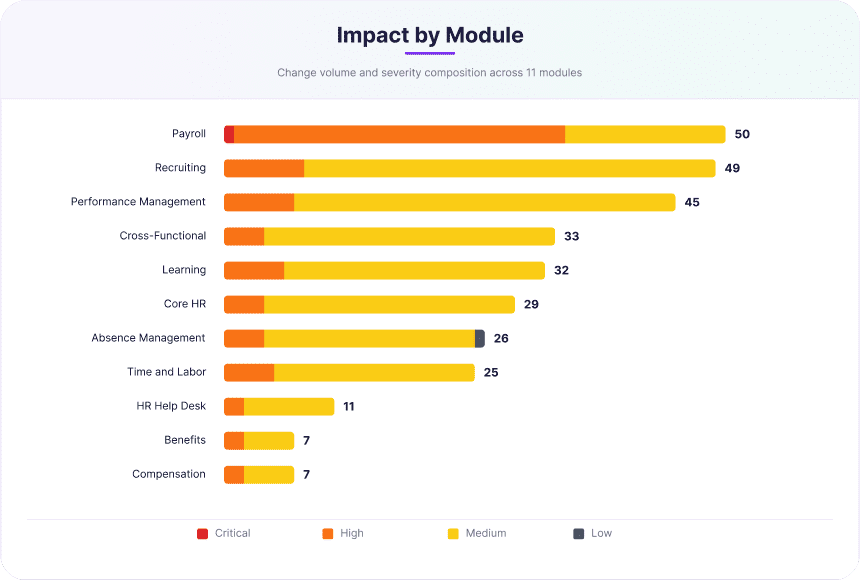
In Opkey’s advisory, these compliance-sensitive items are grouped clearly in Impact by Module and “Critical & High – Compliance” views, so they do not get buried among Redwood UX and cosmetic improvements. This makes it easier for regional HR and payroll leads to quickly see what must be tested and communicated ahead of the Oracle HCM 26B enterprise edition release date.
Why 26B is hard to digest manually
Oracle’s quarterly release model means HCM customers process four major waves of change each year, with preview and production dates tightly scheduled and a standard test window. Oracle HCM 26B release notes span multiple documents across Core HR, Benefits, Learning, Recruiting, Talent, Compensation, and more, making it time‑consuming to connect module-level updates back to your own configuration and usage.
Each update differs in whether it is auto-enabled, opt‑in, or configuration-dependent, whether it touches security, integrations, HCM Extracts, Journeys, or just UI polish, and how much regression is warranted versus a spot check or monitoring. When teams try to manually triage the full catalog to understand which Oracle Cloud HCM 26B release changes actually require action, where AI or agents might introduce new behaviors, and what to prioritize, they lose critical days in the short testing window. This complexity affects both cloud customers and those planning hybrid strategies; while Oracle HCM 26B release date on premises does not apply in the same way as SaaS waves, organizations still need to understand how cloud updates will interact with any on‑premises or third‑party HR systems they integrate with.
What Opkey’s 26B HCM Advisory adds
Opkey’s Oracle Cloud HCM 26B Advisory sits between Oracle’s official “What’s New” documentation and your internal planning, turning Oracle HCM Cloud 26B release notes into an impact, ownership, and testing lens. In a single, dashboard-style PDF, it gives team:
- An Executive Snapshot across HCM modules, summarizing volume of changes, severity, and enablement type.
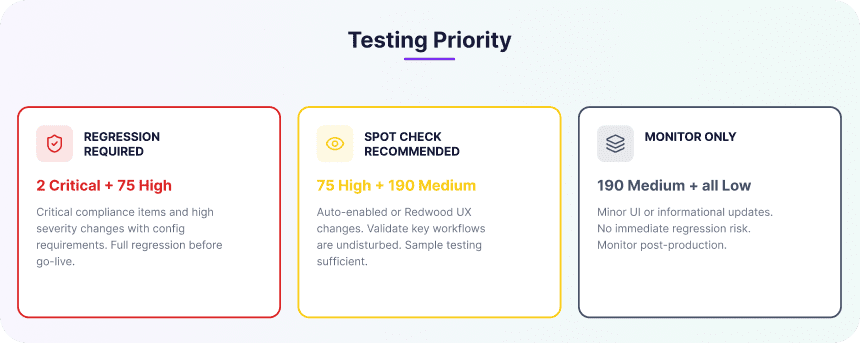
- A Severity and Testing Priority breakdown, mapping changes to test levels such as full regression, focused test, or monitor.
- A “What To Do This Week — By Role” section, showing actions for HR leadership, HR operations, Payroll, Benefits, Learning, Talent, and IT/Integration teams.
- Impact by Module views so module owners can see their slice of 26B without wading through the entire catalog.
- Dedicated callouts for AI and agentic features, Redwood-driven experience changes, opt‑in expiry, and enablement.
Here is a sneak peek!
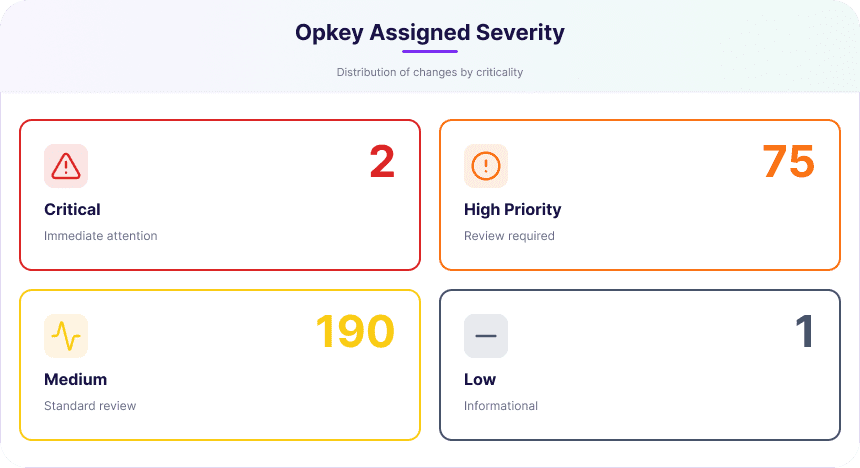
The advisory organizes changes into bands such as Critical, High, and Medium, then maps them to test strategy and ownership rather than leaving everything as one long list. It also clearly distinguishes between auto-enabled features that will go live with the Oracle Cloud HCM 26B release and optional or configuration‑dependent items, which is vital given the pace of Redwood and agent rollout.
How Opkey Release Advisor takes it further
The advisory PDF is the curated overview; Opkey Release Advisor is where the detail becomes interactive and environment aware. Release Advisor carries full context for each Oracle HCM release 26B change, including severity, configuration impact, enablement type, module, and recommended test level.
Teams can query the 26B catalog in natural language with prompts such as:
- “Which 26B updates impact our Journeys and onboarding workflows?”
- “Which 26B changes are auto‑enabled for Learning and what do we need to regression test?”
- “Which Oracle HCM 26B new features relate to AI agents that our HR team must communicate and train on?”
Opkey Release Advisor also helps generate test plans and accelerates test case selection using Opkey’s automation library, tying Oracle HCM 26B release notes back to concrete test coverage. It surfaces AI and agentic features such as document assistants, Core HR agents, Benefits and court order agents, and Learning administration enhancements, all of which may require change management, policy review, and leadership sign‑off, not just configuration work.
Where the PDF offers a summarized view of the Oracle Cloud HCM 26B release, Release Advisor lets teams slice the catalog by module, geography, severity, enablement, or test level and translate those slices into concrete actions inside Opkey.
A quick impact snapshot
A few examples illustrate how Opkey’s impact view changes the conversation:
- Core HR AI assistants for managing jobs are highlighted as high‑impact for HR operations and data governance, with recommended regression for job creation, updates, and security checks.
- Benefits Certification Agent and Court Order Intake Assistant are called out as high‑impact for Benefits and Payroll, tagged as features that require both testing and HR policy review before broad rollout.
- Redwood Benefits Enrollment life event display and guided flows are tagged for UX validation and training, ensuring employee self‑service and manager journeys behave as expected across devices and languages.
- Learning enhancements such as an improved instructor activity center and virtual classroom management are grouped for Learning and L&D leads, with emphasis on testing Teams integration, calendar flows, and attendance tracking.
In the advisory, these appear not just as rows but as part of “Critical Experience & Compliance,” role-based actions, AI and agent reviews, and opt‑in planning sections, helping teams see the connections across modules.
How to use this for 26B planning
A practical way to approach the Oracle Cloud HCM 26B release is to start by downloading Opkey’s Oracle Cloud HCM 26B Advisory from the Oracle Advisory landing page and reviewing the Executive Snapshot with HR, IT, and regional leads. From there, teams can use the “What To Do This Week — By Role” section to assign owners across HR leadership, HR operations, Payroll, Benefits, Learning, Talent, and IT/Integration.
Next, open Opkey Release Advisor and use its prompt guide to explore Oracle HCM 26B release notes in more detail by module, geography, enablement type, or test level. That makes it easier to convert the Oracle Cloud HCM 26B release into a focused testing and change plan, concentrating regression effort on Critical and High items while relying on spot checks and monitoring where appropriate.
For teams watching timelines, the Oracle HCM 26B release date 2025 pattern continues, with preview and production windows published on Oracle’s readiness and news pages. The same channels share the Oracle HCM 26B enterprise edition release date, while Opkey’s Advisory and Release Advisor help interpret the Oracle HCM 26B release date on premises in the context of integrations and data flows.
Oracle Cloud HCM 26B is dense, but with the right impact lens, teams can see which changes matter, where AI and compliance risks sit, and how to right‑size testing, so the Oracle Cloud HCM 26B release becomes a controlled event, not a fire drill.