Oracle Cloud SCM 26B is a substantial quarterly update, with changes spanning Supply Chain Planning, Procurement, Inventory, Order Management, Manufacturing, Maintenance, and Logistics.
The Oracle Cloud SCM 26B release date for cloud customers follows Oracle’s standard readiness cadence, with readiness content and Oracle Cloud SCM 26B release notes published in late March 2026 ahead of preview environments in early May 2026 and production go‑live in mid‑May 2026, so teams can plan testing before changes hit live supply chain operations.
For supply chain, procurement, and IT teams, the challenge is not just understanding what is new. It is deciding what requires attention, what needs testing, and what should be communicated before the release reaches production. Instead of reviewing lengthy Oracle release notes across every product family, teams need a clear view of which updates impact their specific warehouses, sourcing rules, fulfillment flows, integrations, planning logic, and operating procedures. The Oracle Cloud SCM 26B release also brings more AI, diagnostics, and Redwood-driven UX changes that can quietly affect planning quality, execution performance, and downstream financials if not reviewed.
Opkey’s 26B SCM Advisory and AI-powered Release Advisor simplify Oracle Cloud SCM 26B release notes by turning the long feature list into a focused, risk-based testing and change plan tailored to your environment. With guided insights on the Oracle Cloud SCM 26B release, you can prioritize what to test, where to focus automation, who to involve, and how to prepare ahead of the Oracle Cloud SCM 26B release date, moving from passive reading of release notes to active, confident execution of a release strategy that protects supply chain continuity.
Big themes in Oracle Cloud SCM 26B
Oracle Cloud SCM continues to evolve as a unified, end‑to‑end supply chain platform, and 26B deepens that direction with changes across Supply Chain Planning, Procurement, Inventory Management, Product Lifecycle Management, Order Management, Manufacturing, Maintenance, and Logistics. Opkey’s advisory snapshot breaks this breadth into an at‑a‑glance view of total changes, module coverage, and which items require action versus being auto‑enabled in your tenants.
While Oracle’s official Oracle Cloud SCM 26B release notes call out module-level updates, Opkey overlays an impact lens, highlighting which items affect planning logic, procurement contracts, inventory controls, shipping and fulfillment flows, and integration touchpoints. This is especially important given Oracle Cloud SCM 26B new features around AI agents, root‑cause diagnostics, and Redwood experiences, which often require targeted testing and training rather than just a configuration toggle.
Stronger supply planning, inventory, and fulfillment controls
Several Oracle 26B release updates directly affect how you plan, stock, and fulfill orders. In Supply Chain Planning, new Planning Stockout Advisor and root‑cause diagnostics capabilities help planners identify shortages earlier and understand the drivers behind late orders, demand spikes, or constrained supply. In Inventory and Warehouse Management, enhancements to cycle counting, picking, and put away, combined with Redwood UI and mobile app improvements, aim to make warehouse work more accurate and intuitive.
For supply planning, operations, and logistics teams, these are not “nice‑to‑have” features; changes to planning advisors, stocking logic, or warehouse workflows can alter decision making and KPIs like fill rate or on‑time delivery. In Opkey’s advisory, these items are tagged as high‑impact for regression testing and surfaced in “What To Do This Week” action cards, so owners know they require attention before the Oracle Cloud SCM 26B release date hits production.
Automation, Redwood, and AI in supply chain execution
Oracle Cloud SCM 26B further accelerates Redwood UX, automation, and AI-led insights across supply chain execution, going beyond what a standard Oracle Redwood release note typically conveys about the day‑to‑day experience. In Procurement, for example, the 26B update improves how large contracts are handled: Oracle Fusion Cloud Procurement 26B adds a scheduled process for creating purchasing documents from large contracts, governed by the Contract Line Count Limit for Fulfillment Process Method profile option. This reduces timeouts and improves reliability when processing high-volume agreements.
Across Procurement, Order Management, and Warehouse Management, Redwood UI and mobile enhancements create more intuitive pages and flows for buyers, planners, and warehouse staff, while AI-driven diagnostics and advisors help teams see issues faster and take action. These updates may not always change configuration dramatically, but they can significantly alter how day‑to‑day work is executed on the shop floor, in the warehouse, and in control towers.
In the advisory, Opkey flags these Redwood and AI-driven updates with pre-assigned testing and communication priorities and rolls them into module-level impact views, so teams can see where UX and AI changes will impact SOPs, training, and change management.
Risk, compliance, and contract governance
For procurement, quality, and audit teams, Oracle Cloud SCM 26B also introduces changes that affect contractual controls and auditability. In Procurement Contracts, the ability to process large contracts via scheduled processes, controlled by a profile option, can change how contract fulfillment jobs run and how you monitor them. In Product Lifecycle Management and quality-related modules, enhancements to change orders and product data management can influence how new products and revisions move through the lifecycle.
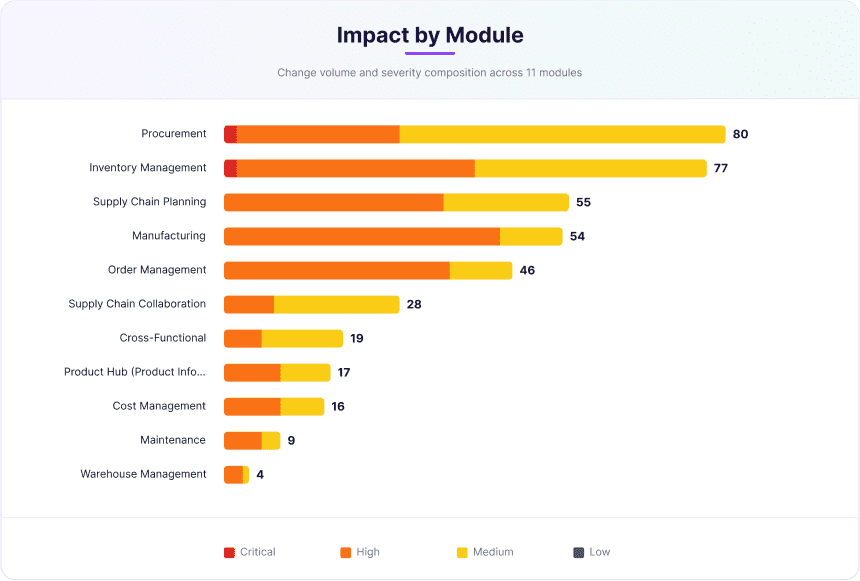
In Opkey’s advisory, these compliance- and control-sensitive items are grouped clearly in Impact by Module and “Critical & High – Controls & Compliance” views, so they do not get buried among Redwood UI and usability enhancements. This makes it easier for procurement, quality, and audit leads to quickly see what must be tested and communicated ahead of the Oracle Cloud SCM 26B release.
Why SCM 26B is hard to digest manually
Oracle’s quarterly release model means SCM customers process four waves of change each year, with preview and production dates tightly scheduled and a standard testing window. Oracle Cloud SCM 26B release notes span multiple documents; Supply Chain Planning, Procurement, Inventory, PLM, Order Management, Manufacturing, Maintenance, Logistics, and more—making it time‑consuming to connect module-level updates back to your own configuration, network, and processes.
Each update differs in whether it is auto‑enabled, opt‑in, or configuration-dependent, whether it touches planning logic, controls, integrations, or just UX polish, and how much regression is warranted versus a spot check or monitoring. When teams try to manually triage the full catalog to understand which Oracle Cloud SCM 26B release changes require action, where AI or Redwood-driven features might introduce new behaviors, and what to prioritize, they can lose critical days in the short testing window.
What Opkey’s 26B SCM Advisory adds
Opkey’s Oracle Cloud SCM 26B Advisory sits between Oracle’s official “What’s New” documentation and your internal planning, turning Oracle Cloud SCM 26B release notes into an impact, ownership, and testing lens. In a single, dashboard-style PDF, it gives teams:
- An Executive Snapshot across SCM modules, summarizing the volume of changes, severity, and enablement type.
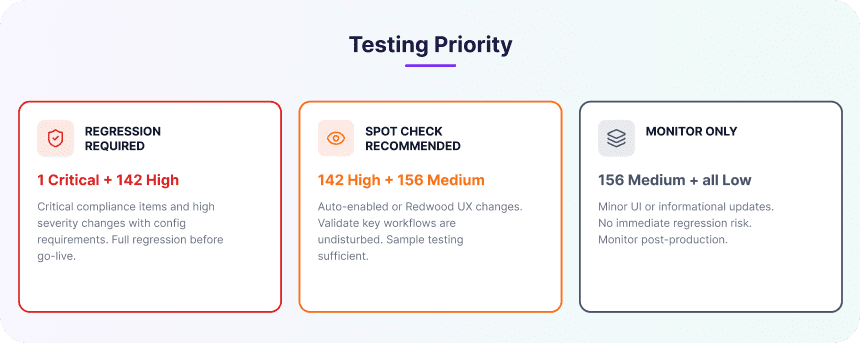
- A Severity and Testing Priority breakdown, mapping changes to test levels such as full regression, focused test, or monitor only.
- A “What To Do This Week — By Role” section, showing actions for supply chain leaders, planners, warehouse operations, procurement, logistics, and IT/integration teams.
- Impact by Module views so module owners can see their slice of 26B without wading through the entire catalog.
- Dedicated callouts for AI agents, Redwood-driven experience changes, opt‑in expiry, and enablement.
Here is a sneak peek!
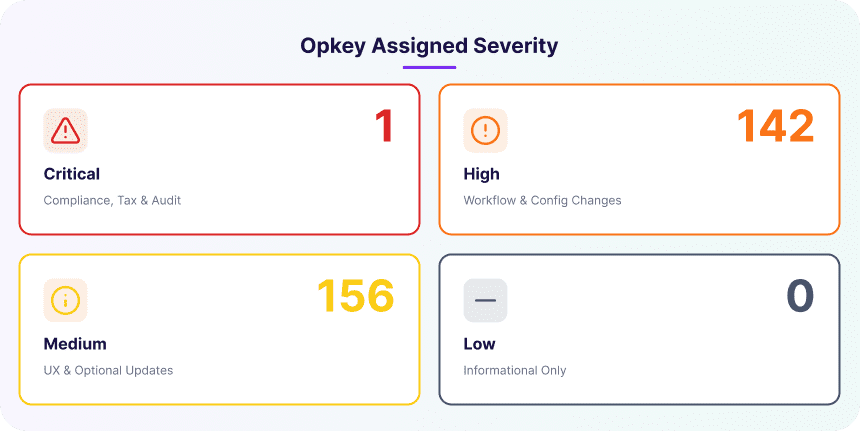
The advisory organizes changes into bands such as Critical, High, and Medium, then maps them to test strategy and ownership, rather than leaving everything as one long list. It also clearly distinguishes between auto‑enabled features that will go live with the Oracle Cloud SCM 26B release and optional or configuration-dependent items, which is critical given the pace of AI and Redwood rollout.
How Opkey Release Advisor takes it further
The advisory PDF is the curated overview; Opkey Release Advisor is where the detail becomes interactive and environment‑aware. Release Advisor carries full context for each Oracle Cloud SCM 26B change, including severity, configuration impact, enablement type, module, and recommended test level.
Teams can query the 26B catalog in natural language with prompts such as:
- “Which 26B updates impact our supply planning and ATP commitments?”
- “Which 26B changes are auto‑enabled for Inventory and Warehouse Management and what do we need to regression test?”
- “Which Oracle Cloud SCM 26B new features affect procurement contracts and order orchestration flows?”
Opkey Release Advisor also helps generate test plans and accelerates test case selection using Opkey’s automation library, tying Oracle Cloud SCM 26B release notes back to concrete test coverage. It surfaces AI and agentic features such as planning advisors, warehouse insights, and diagnostics enhancements, all of which may require process changes, SOP updates, and leadership sign‑off not just configuration work.
Where the PDF offers a summarized view of the Oracle Cloud SCM 26B release, Release Advisor lets teams slice the catalog by module, geography, severity, enablement, or test level and translate those slices into concrete actions inside Opkey.
A quick impact snapshot
A few examples illustrate how Opkey’s impact view changes the conversation:
- Supply Chain Planning AI advisors and stockout diagnostics are highlighted as high‑impact for planners, with recommended regression on demand, supply, and order delay scenarios.
- The scheduled processing capability for large procurement contracts in update 26B is tagged as high‑impact for Procurement and IT, with focus on job scheduling, monitoring, and downstream purchasing document creation.
- Redwood-based enhancements to warehouse mobile flows and picking operations are flagged for UX validation and training, ensuring warehouse staff can adopt new flows without productivity dips.
- PLM and product data changes are grouped for product and quality leads, emphasizing testing of change orders, approvals, and downstream manufacturing and sourcing integrations.
In the advisory, these appear not just as rows but as part of “Critical Experience & Controls,” role-based actions, AI and diagnostics reviews, and opt‑in planning sections, helping teams see connections across modules.
How to use this for 26B planning
A practical way to approach the Oracle Cloud SCM 26B release is to start by downloading Opkey’s Oracle Cloud SCM 26B Advisory from the Oracle Advisory landing page and reviewing the Executive Snapshot with supply chain, operations, procurement, and IT leads. From there, teams can use the “What To Do This Week — By Role” section to assign owners across planning, warehouse operations, procurement, logistics, and integration teams.
Next, open Opkey Release Advisor and use its prompt guide to explore Oracle Cloud SCM 26B release notes in more detail by module, geography, enablement type, or test level. That makes it easier to convert the Oracle Cloud SCM 26B release into a focused testing and change plan, concentrating regression effort on Critical and High items while relying on spot checks and monitoring where appropriate.
For teams watching timelines, the established quarterly cadence continues, with preview and production windows published on Oracle’s readiness and news pages alongside Oracle Cloud SCM 26B release notes. Oracle’s readiness channels provide the same clarity for environment timelines that you see in other Oracle Cloud releases, while Opkey’s Advisory and Release Advisor help interpret those dates in terms of integrations, warehouses, and multi‑tier supply networks.
Oracle Cloud SCM 26B is dense, but with the right impact lens, teams can see which changes matter, where AI, planning, and compliance risks sit, and how to right‑size testing, so the Oracle Cloud SCM 26B release becomes a controlled event, not a fire drill.